Dogs have been our loyal companions for at least 15,000 years, yet they remain one of the most mysterious and fascinating species on the planet. From their incredible sensory capabilities to their complex emotional lives, there is so much more to a dog than wagging tails and wet kisses. Whether you are a lifelong dog owner or just a fan of canine trivia, these facts will challenge everything you thought you knew about your four-legged friends.
The Superpower of the Snout: A World Defined by Smell
To understand a dog, you must first understand its nose. While humans primarily experience the world through vision, dogs “see” the world through their olfactory system.
1. The 100,000x Advantage
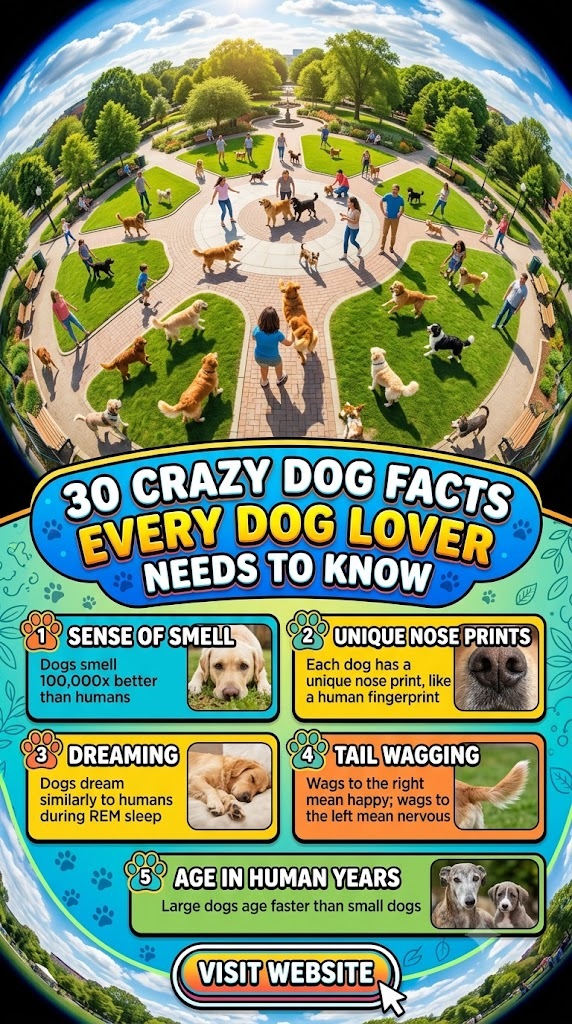
A dog’s sense of smell is between 10,000 and 100,000 times more acute than a human’s. To put that into perspective, if a human could see a candle a mile away, a dog could see that same candle from 3,000 miles away. They can detect a single teaspoon of sugar dissolved in a million gallons of water—roughly the amount found in two Olympic-sized swimming pools.
2. The Unique “Nose Print”
Just as humans have unique fingerprints that can be used for identification, dogs have unique nose prints. The patterns of ridges and creases on a dog’s nose are entirely distinct to the individual. In some parts of the world, organizations have even started using nose prints as a way to track lost or stolen pets.
3. Breathing and Smelling Simultaneously
Unlike humans, who must choose between inhaling and exhaling, dogs have a fold of tissue inside their nostrils that separates the functions of smelling and breathing. When a dog breathes in, a portion of the air goes into a dedicated olfactory area while the rest goes to the lungs. When they exhale, the air exits through the slits on the sides of their noses, creating a swirl of air that actually helps pull in new scent molecules.
4. Detecting Disease and Emotion
A dog’s nose is so sensitive it can detect chemical changes in the human body. Dogs have been trained to sniff out:
- Cancer: Including lung, breast, and skin cancers.
- Diabetes: By detecting a drop in blood sugar levels through a person’s breath or sweat.
- Seizures: Many dogs can alert their owners minutes before a seizure occurs.
- Stress: They can smell the “cortisol” spikes in our sweat when we are anxious or afraid.
The Secret Language of Canines: Decoding Communication
We often think we understand what our dogs are saying, but canine communication is far more nuanced than just barking or whining.
5. The Direction of the Wag
A tail wag doesn’t always mean a dog is happy. Research shows that the direction of the wag matters.
- Right-leaning wag: Usually indicates the dog is relaxed, happy, or approaching something they like.
- Left-leaning wag: Often indicates anxiety, fear, or uncertainty. This is linked to the different hemispheres of the brain controlling different emotional responses.
6. The Science of the “Guilty Look”
We’ve all seen it: the tucked tail, the lowered head, and the “whale eye” (showing the whites of the eyes) after a dog does something wrong. However, studies have shown that this isn’t actually “guilt.” Instead, it is a submissive reaction to the owner’s disappointed body language or tone of voice. Dogs live in the moment; they don’t necessarily connect the chewed-up shoe from three hours ago with your current anger, but they know you’re upset now and are trying to appease you.
7. Barking is a Domestication Trait
In the wild, wolves rarely bark; they howl, whine, and growl. Barking is a behavior that dogs developed primarily to communicate with humans. It is an “attention-seeking” mechanism that evolved as dogs moved closer to human settlements and realized that loud, repetitive sounds were the best way to get our attention.
8. The “Play Bow” is a Meta-Communication
When a dog drops their front chest to the ground while keeping their rear in the air, they are performing a “play bow.” This is a crucial communication tool that tells the other dog (or human), “Everything I do from this moment on—biting, growling, lunging—is just a joke.” It’s the canine equivalent of saying “No offense” before a sarcastic comment.
Historical Hounds: Dogs That Changed the World
Dogs haven’t just been sitting on our couches; they’ve been on the front lines of history, science, and even the high seas.
9. The Survivors of the Titanic
When the RMS Titanic sank in 1912, there were twelve dogs confirmed to be on board. Only three survived. All three were small dogs—two Pomeranians and one Pekingese—which were easily carried into lifeboats by their owners, often wrapped in blankets to look like babies or hidden inside coats.
10. Ancient Greek “Seeing Eye” Dogs
The concept of service dogs is not new. Evidence from the first century AD in the ruins of the Roman city of Herculaneum suggests that dogs were used to lead the blind. A wall painting found there depicts a blind man being led through a marketplace by a small dog.
11. Laika: The First Earthling in Orbit
In 1957, a stray dog from the streets of Moscow named Laika became the first living creature to orbit the Earth. While her journey was a one-way trip, she paved the way for human spaceflight, proving that living organisms could withstand the launch and weightlessness of space.
12. The Bloodhound’s Legal Testimony
A Bloodhound’s sense of smell is so reliable that it is the only animal whose “testimony” is admissible in a U.S. court of law. If a Bloodhound follows a scent trail from a crime scene to a suspect, that evidence can be used to help secure a conviction.
Anatomy and Biology: The Internal Workings of a Dog
The physical makeup of a dog is a masterpiece of evolution, designed for endurance, speed, and survival.
13. Sweating Through the Paws
You might notice that on a hot day, your dog leaves damp paw prints on the floor. This is because dogs only have sweat glands in their paw pads. To cool the rest of their bodies, they rely on panting, which evaporates moisture from their tongues and lungs.
14. The “Third Eyelid”
Dogs have a third eyelid called a “nictitating membrane.” This clear or translucent layer sits in the corner of the eye and sweeps across the eyeball to protect it and keep it moist. If you’ve ever seen your dog sleeping with their eyes slightly open and a white film covering the eye, you’re seeing the nictitating membrane in action.
15. Ears Powered by 18 Muscles
A human ear is controlled by six muscles, most of which are vestigial (we can’t really move them). A dog, however, has at least 18 muscles per ear. This allows them to tilt, rotate, and move each ear independently to pinpoint the exact source of a sound.
16. The Speed of a Greyhound
The Greyhound is the second fastest land animal on Earth, surpassed only by the Cheetah. They can reach speeds of up to 45 miles per hour. What makes them so fast? A “double-suspension gallop” where all four feet leave the ground twice during each stride. Furthermore, a Greyhound’s heart is significantly larger and beats more slowly than other dogs, allowing for massive bursts of oxygenated blood.
Cognitive Wonders: How Smart is Your Dog?
Recent studies in canine cognition have revealed that dogs are much smarter than we previously imagined.
17. The Intelligence of a Two-Year-Old
According to canine researchers, the average dog has the mental ability and vocabulary of a 2-year-old human child. They can learn about 165 words, including signals and gestures. “Super dogs” (the top 20% of intelligence) can learn up to 250 words.
18. Dogs Can Count and Do Simple Math
In various experiments, dogs have shown the ability to count up to five and notice when simple mathematical equations are wrong. For example, if you put two treats behind a screen and then show the dog that only one treat is left when the screen is lifted, the dog will stare significantly longer at the scene, indicating they realize something is missing.
19. The “Self-Awareness” Test
While dogs often fail the classic “mirror test” (recognizing themselves in a mirror), they pass the “olfactory mirror test.” When presented with their own urine and the urine of other dogs, they spend much less time sniffing their own, proving they recognize their own scent and distinguish it from others.
20. Chaser the Border Collie
The smartest dog on record was a Border Collie named Chaser. She knew the names of over 1,000 unique objects. She could be told to “Find Darwin” (a specific toy) among a pile of hundreds, and she would successfully retrieve it every time.
Breed-Specific Oddities: From Barkless Dogs to Blue Tongues
Different breeds have evolved or been bred for specific tasks, leading to some truly bizarre physical traits.
21. The Barkless Basenji
The Basenji, an ancient African hunting breed, is known as the “barkless dog.” Due to the unique shape of their larynx, they cannot produce a traditional bark. Instead, they make a sound often described as a “yodel” or a “barroo.”
22. The Blue Tongues of the Chow Chow
The Chow Chow and the Shar-Pei are the only two dog breeds in the world that have completely blue or black tongues. The reason for this is still largely a genetic mystery, though some suggest it was a trait selected by ancient breeders to make the dogs look more intimidating.
23. The Lundehund’s Six Toes
The Norwegian Lundehund was bred to hunt puffins on steep, slippery cliffs. To help them grip the rocks, they evolved to have six toes on each foot. They are also incredibly flexible; they can tip their heads backward until they touch their spines and fold their ears shut to protect against moisture.
24. The Dalmatians’ Spotless Start
Everyone knows Dalmatians for their iconic black spots, but did you know they are born completely white? The spots begin to develop when the puppies are about 10 to 14 days old and continue to appear as the dog grows into adulthood.
Health and Longevity: Keeping the Tail Wagging
Understanding dog health can help extend the life of your companion.
25. Why They Curl Up in a Ball
When a dog sleeps, they often curl into a tight ball. This is an age-old instinct. In the wild, this position protects their vital organs from predators and helps them conserve body heat.
26. The Chocolate Danger
Most people know chocolate is bad for dogs, but many don’t know why. It’s because of a chemical called theobromine. Humans can metabolize it quickly, but dogs cannot. It builds up in their system and can cause heart palpitations, seizures, and even death. The darker the chocolate, the more theobromine it contains.
27. Wet Noses for Cooling and Catching
Why is a dog’s nose always wet? It serves two purposes. First, it helps them stay cool through evaporation. Second, the thin layer of mucus on the nose helps absorb scent chemicals. The dog then licks their nose to “taste” the scents and move them to the Jacobson’s organ in the roof of their mouth for deeper analysis.
28. The Paradox of Size and Lifespan
In the animal kingdom, larger animals usually live longer (think elephants vs. mice). However, dogs are the opposite. Small breeds like Chihuahuas can live for 15-20 years, while giant breeds like Great Danes often only live for 7-10 years. Scientists believe this is because large dogs age at an accelerated rate, putting more stress on their physiological systems.
Pop Culture Pups: Famous Fidos
Dogs have a massive presence in our cultural history, often becoming celebrities in their own right.
29. Paul McCartney’s Secret Whistle
At the end of the Beatles’ song “A Day in the Life,” Paul McCartney edited in a high-frequency whistle that is inaudible to human ears but perfectly audible to dogs. He did it specifically for his Shetland Sheepdog, Martha. If your dog perks up at the end of that song, now you know why!
30. Rin Tin Tin’s 27 Movies
Rin Tin Tin was a real German Shepherd rescued from a World War I battlefield. He became a massive Hollywood star, appearing in 27 films. He was so popular that it is rumored he received the most votes for the very first Academy Award for Best Actor in 1929, but the Academy wanted a human to win.
31. The Inspiration for Chewbacca
George Lucas, the creator of Star Wars, had a large Alaskan Malamute named Indiana. This dog would sit in the passenger seat of Lucas’s car like a co-pilot. This image—and the dog’s shaggy appearance—became the direct inspiration for the character of Chewbacca. (And yes, “Indiana” Jones was also named after the dog!)
Dogs and Human Connection: A Biological Bond
The bond between a dog and a human is more than just friendship; it’s a biological synchronization.
32. The “Love Hormone” Overlap
When you look into your dog’s eyes, both you and your dog experience a surge in oxytocin, the same hormone that bonds mothers to their newborn babies. This “eye contact loop” is unique to dogs and humans; wolves do not look humans in the eye in the same way.
33. Dogs Can Feel Jealousy
A study at the University of California, San Diego, found that dogs truly do feel jealousy. When owners showed affection to a stuffed, animatronic dog that barked and wagged its tail, the real dogs displayed aggressive or attention-seeking behaviors, trying to get between the owner and the “rival.”
34. They Dream Just Like Us
If you’ve ever seen your dog’s paws twitch or heard them give a muffled “woof” in their sleep, they are dreaming. Studies of dog brain waves have shown that they go through the same stages of sleep as humans, including REM (Rapid Eye Movement) sleep, which is where dreaming occurs. They likely dream about common activities like chasing a squirrel or playing fetch.
Miscellaneous Canine Curiosities
To wrap up our journey, here are some final facts that defy categorization.
35. Dogs Prefer the Earth’s Magnetic Field
A study published in the journal Frontiers in Zoology suggests that dogs prefer to poop and pee in alignment with the Earth’s north-south magnetic axis. They are sensitive to small variations in the magnetic field, though they usually only align themselves this way when the magnetic field is “calm.”
36. The World’s Oldest Dog
The oldest dog ever recorded was an Australian Cattle Dog named Bluey. He lived to be 29 years and 5 months old. He worked among sheep and cattle for nearly 20 years before passing away in 1939.
37. Yawns are Contagious
Just as humans “catch” yawns from one another, dogs catch yawns from humans. Interestingly, dogs are more likely to catch a yawn from their owner than from a stranger, suggesting that contagious yawning in dogs is linked to empathy and social bonding.
38. Three Dogs Survived the Titanic
It bears repeating because of the sheer odds. While hundreds of people perished, three small dogs made it onto lifeboats. Their survival is a testament to the lengths people will go to save their “best friends,” even in the midst of a global tragedy.
39. The “Newfoundlands” are Lifeguards
Newfoundlands have water-resistant coats and webbed feet. They were originally bred to help fishermen haul nets and rescue people from the freezing water. They are such strong swimmers that a single Newfoundland is capable of pulling a small boat to shore or saving multiple drowning people at once.
40. The Puppy Breath Mystery
That distinct “puppy breath” that many owners love is actually caused by gases given off by the bacteria in a puppy’s developing digestive system, combined with the fact that they are still drinking their mother’s milk. As they transition to solid food and their gut microbiome matures, the smell disappears.
Conclusion: A Bond Like No Other
From their ability to detect sickness before a doctor can, to their ancient history as protectors and hunters, dogs are truly extraordinary creatures. They have evolved alongside us, learning to read our emotions, understand our language, and even manipulate our hormones to ensure they are loved and cared for.
The next time you look at your dog, remember that you aren’t just looking at a pet. You are looking at a biological marvel, a historical hero, and a sentient being with a rich internal life that we are only just beginning to understand. Whether they are “barkless” yodelers, six-toed cliff climbers, or just a loyal companion on the sofa, dogs truly are the greatest friends humanity has ever had.