The Hidden Language of Dogs: Decoding the Secret Meaning Behind Every Tail Wag
In the complex world of canine communication, the tail is less like a “happy meter” and more like a sophisticated emotional semaphore. It is a biological signaling device that conveys nuance, social standing, internal conflict, and even neurological dominance. To truly understand your dog, you must move beyond the myth of the “happy wag” and learn to read the subtle dialects of the tail.
1. The Great Misconception: A Wag Does Not Always Mean “Friendly”
The most important lesson in canine ethology is this: A wagging tail simply indicates social arousal or engagement. It is an “on” switch for communication, but it doesn’t tell you the content of the message by itself.
Think of a tail wag like a human smile. While we usually smile when we are happy, we also smile when we are nervous, when we are being polite to someone we dislike, or even when we are masking a threat. A dog wagging its tail is merely saying, “I am ready to interact” or “I am reacting to what is happening.” Whether that interaction will be a lick to the face or a defensive snap depends on the height, speed, and direction of that wag.
2. The Science of the “Side-Bias”: Left vs. Right Wagging
One of the most fascinating breakthroughs in veterinary science involves the lateralization of the brain. Much like humans, a dog’s brain is divided into two hemispheres, each controlling different emotional responses. Because the left side of the brain controls the right side of the body (and vice versa), the direction of a wag reveals a dog’s internal state.
The Right-Leaning Wag (Positive)
When a dog feels relaxed and approach-oriented—usually when seeing their owner or a familiar friend—their tail tends to wag more heavily toward the right side of their body. This indicates activation in the left hemisphere of the brain, which is associated with positive, “pro-social” emotions.
The Left-Leaning Wag (Negative/Anxious)
Conversely, when a dog encounters something stressful, such as an unfamiliar, dominant dog or a person they find threatening, the tail wags more toward the left. This indicates right-hemisphere activation, which governs withdrawal, fear, and “fight-or-flight” responses.
Interestingly, other dogs can read these subtle directional cues. Studies have shown that when dogs see another dog wagging to the left, their own heart rates increase and they show signs of stress. When they see a right-leaning wag, they remain calm.
3. The Height of the Tail: Establishing Social Hierarchy
The “altitude” of a dog’s tail acts as a public broadcast of their confidence and social status in any given moment.
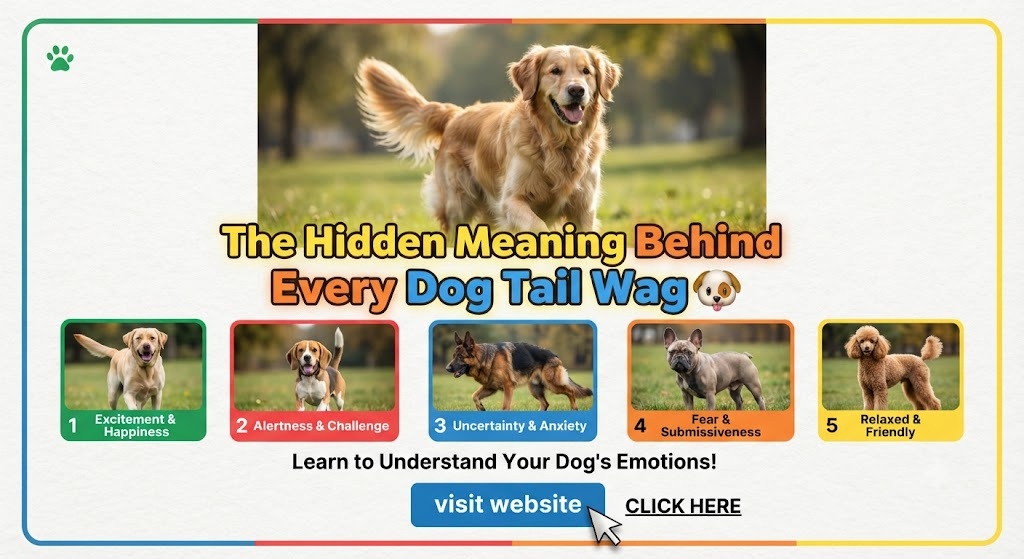
- High and Rigid (The Flag): When a tail is held high, often arching over the back, it signals high arousal and dominance. This is a “flagging” motion. The dog is making itself look larger and more imposing. If the tip is vibrating quickly, it can be a sign of imminent aggression.
- Middle/Horizontal: This is the neutral zone. A tail held out behind the dog, level with the spine, suggests a dog that is curious but relaxed. They are surveying their environment without feeling the need to dominate or hide.
- Low or Tucked: A tail held below the spine indicates submissiveness, worry, or fear. When the tail is tucked tightly between the hind legs, the dog is literally trying to “shut down” its scent markers (the anal glands) to become “invisible” and signal that they are not a threat.
4. Speed and Breadth: The “Vibe” of the Wag
If height tells us the status, speed tells us the intensity of the emotion.
The Broad, Full-Body Wag
Often called the “wiggle-butt,” this is the gold standard of canine joy. The tail moves in wide, sweeping arcs, and the motion is so intense it causes the dog’s entire hips or even their whole body to curve into a “C” or “S” shape. This is a sign of pure, unadulterated pleasure and lack of threat.
The Helicopter Wag
When a dog’s tail moves in a circular, propeller-like motion, you’ve hit the jackpot. This is almost exclusively reserved for the most beloved people in a dog’s life. It is the highest expression of “I love you” in the canine dictionary.
The Short, High-Speed Vibration
This is the most dangerous wag to misinterpret. If a dog’s tail is held high and is vibrating or “shivering” rapidly, it is a sign of extreme tension. The dog is highly “loaded” and ready to react. In many cases, this is a precursor to a bite. If you see this, do not approach.
The Slow, Tentative Wag
A slow, rhythmic wag at a medium height often indicates that the dog is “processing” or feeling ambivalent. They aren’t sure if you’re a friend or a foe yet. They are checking for cues.
5. The Tail as a Scent Diffuser
To understand why dogs wag their tails, we have to look at their primary sense: smell. Dogs have anal glands located on either side of the rectum that produce a unique pheromonal “ID card.”
When a dog wags its tail, the motion acts as a fan, spreading their personal scent into the air to inform other dogs of their presence, health, and mood. This is why a confident dog holds its tail high—it wants to broadcast its scent as far as possible. Conversely, a frightened dog tucks its tail to “hide” its scent, much like a person might try to stay quiet while hiding in a dark room.
6. Interpreting the Tail in Context: The Full-Body Picture
You cannot read a tail in isolation. To truly decode the “Hidden Meaning,” you must look at the rest of the dog’s “body grammar.”
| Tail Signal | Accompanying Body Language | Meaning |
|---|---|---|
| Fast, wide wag | Soft eyes, open mouth (smile) | Genuine happiness and playfulness. |
| High, stiff wag | Stiff legs, “whale eye” (showing whites) | Potential aggression; the dog is over-stimulated. |
| Low, slow wag | Lowered head, licking lips | Submission or “I’m sorry” (appeasement). |
| Tucked tail | Trembling, pinned back ears | Extreme fear or anxiety. |
| Horizontal, still | Forward-leaning body, closed mouth | Intense focus or tracking (hunting mode). |
7. Breed Variations: When the Tail Lies (or Changes Language)
Not all tails are created equal. Evolution and human breeding have altered the physical structure of tails, which can lead to “translation errors” between dogs.
- Pugs and Spitz Breeds: These dogs have tails that naturally curl over their backs. To other dogs, this can sometimes look like a permanent “dominant” or “aggressive” signal, even if the dog is friendly.
- Greyhounds and Whippets: Their natural “resting” position for the tail is low and tucked. What looks like fear in a Lab is simply the default state for a sighthound.
- Docked Tails (Boxers, Dobermans): Dogs with docked tails have a significant communication disadvantage. They have to rely more on “butt-wiggling” and ear position to get their point across, and they are more likely to be misunderstood by other dogs.
8. Common Scenarios and What They Really Mean
“The Mailman Wag”
When your dog barks at the window with a wagging tail as the mailman approaches, many owners think, “Oh, he wants to play!” In reality, this is often a threat wag. The dog is aroused and alert, using the tail to spread its scent and signal its territory.
“The Guilt Wag”
You come home to a chewed-up shoe. Your dog’s tail is low and wagging slowly. Science tells us dogs don’t feel “guilt” in the human sense. This is an appeasement wag. The dog is reading your angry body language and using its tail to say, “I am small and not a threat, please don’t be angry.”
“The Sleep Wag”
Have you ever seen your dog’s tail thump against the floor while they are deep in sleep? This is a physical manifestation of the REM cycle. Dogs dream about their daily activities, and a sleep wag usually indicates they are “virtually” interacting with a friend or chasing a squirrel in their mind.
9. How to “Speak Dog” Using This Knowledge
Now that you know the hidden meanings, how can you use this to improve your relationship with your dog?
- Respect the “No”: If you see a high, stiff, vibrating wag, give the dog space. They are telling you they are overwhelmed.
- Watch the Left-Leaning Wag at the Vet: If your dog starts wagging to the left when entering the clinic, acknowledge their anxiety. Use treats and calming tones to shift their emotional state.
- Don’t Force Socialization: If your dog approaches another dog with a low, tucked wag, they are feeling insecure. Don’t force them to “say hi.” Let them retreat to their safe zone.
- Mirror the Energy: If you want to calm a dog down, don’t engage with their high-energy wagging. Stay still, keep your hands low, and wait for the “wiggle” to settle into a relaxed, mid-level rhythm.
10. The Evolution of the Wag: Why Did It Develop?
The tail was originally a tool for physical balance. When a wolf or an early canine ancestor was chasing prey at high speeds, the tail acted as a counterweight during sharp turns.
However, as dogs became social pack animals, the tail evolved into a communication tool. Because dogs live in a world where physical conflict can lead to fatal injuries, they developed a complex system of “non-verbal” negotiation. The tail wag allows dogs to settle disputes, establish hierarchy, and express affection without ever having to use their teeth. It is an evolutionary masterpiece of conflict resolution.
Conclusion: Listening with Your Eyes
The next time you look at your dog’s tail, remember that you are looking at a direct window into their nervous system. That wagging tail is a story being told in real-time—a story of how they feel about the world, how they feel about you, and how they feel about themselves.
By paying attention to the direction, the height, and the tension of the wag, you move beyond being just an “owner” and become a true partner. You begin to hear what they are saying in the silence. The hidden meaning behind every tail wag isn’t just about “happiness”—it’s about a profound, ancient connection between two species, expressed through the simple, beautiful flick of a tail.